Every business running Google Ads for the first time hits the same fork in the road. The platform is technically open to anyone with a credit card, so it feels like something you could just learn and run yourself. At the same time, every agency pitch makes it sound like DIY is a guaranteed way to burn your budget.
The honest answer sits in between, and it depends heavily on your budget, your time, and how much is actually riding on the campaign working. This guide walks through exactly where DIY holds up, where it breaks down, and what a genuine Google Ads agency in India should be doing differently, so you can make the decision based on your actual situation rather than whichever pitch you heard most recently.
This question comes up constantly alongside a related one: whether to invest in Google Ads at all versus organic SEO services, or some mix of both. That comparison deserves its own answer, but the short version is that paid and organic serve different timelines, paid for speed, SEO for long-term compounding, and most mature businesses eventually run both rather than choosing one permanently.
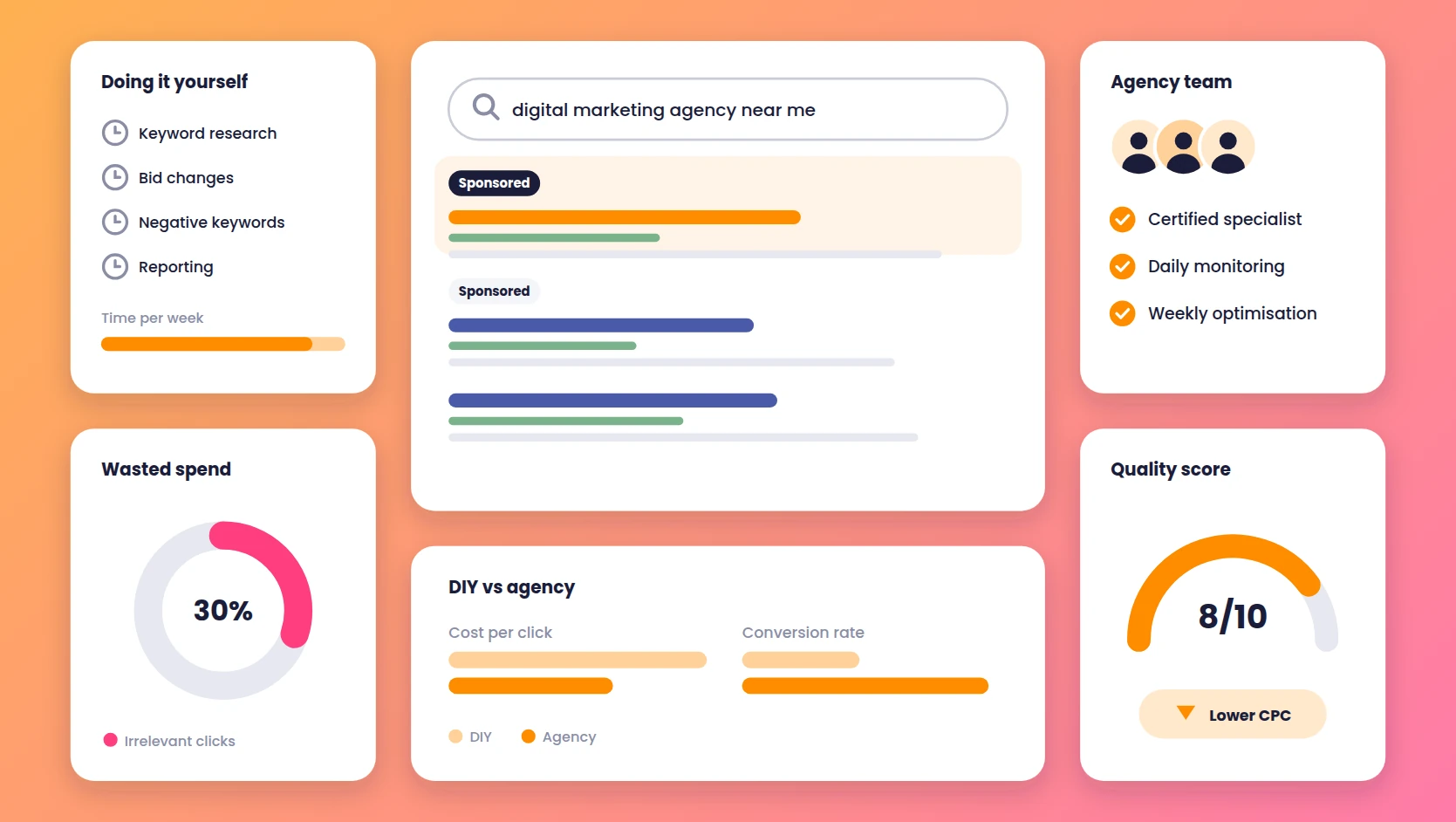
What Running Google Ads Yourself Actually Involves
Google Ads looks simple on the surface: pick some keywords, write an ad, set a budget, launch. The reality involves a lot more moving parts than the setup wizard suggests.
- Keyword research that separates high-intent searches from broad, expensive traffic that rarely converts
- Negative keyword lists to stop your budget from being spent on searches that look related but are not
- Ad copy testing, since the first version you write is rarely the best-performing one
- Landing page alignment, because a mismatched landing page can tank your Quality Score and inflate your cost per click
- Conversion tracking setup, which needs to be technically correct or every other decision you make is based on bad data
- Ongoing bid and budget adjustments, ideally weekly, based on what the data is actually showing
None of these steps are impossible to learn. The real cost is the time it takes to learn them properly, during which your ad spend is effectively funding your education. Most business owners underestimate this specifically because the Google Ads interface is designed to get a campaign live in minutes, which creates a false sense that the hard part is over once the campaign launches. In reality, launching is the easy five percent. The other ninety-five percent is the weekly discipline of reviewing, testing, and adjusting.
DIY vs Agency: What Actually Changes
Where DIY Genuinely Works Fine
DIY is not automatically the wrong choice. It makes sense in a few specific situations.
- You are testing a genuinely new business idea and want to validate demand before investing in a bigger setup
- Your monthly budget is small enough that even a full-scope agency retainer would cost more than the ad spend itself
- You or someone on your team already has real hands-on Google Ads experience, not just a certification
- You are running a single, simple campaign type, such as local search ads for one service, rather than a multi-campaign account
If most of these apply to you, spending a few weeks learning the platform on a small budget is a reasonable way to start, as long as you are honest with yourself about the learning curve. The businesses that do this well tend to treat the first month explicitly as a learning budget, expecting some inefficiency, rather than assuming every rupee spent from day one should convert perfectly.
Where DIY Usually Breaks Down
The pattern that shows up most often with businesses that eventually switch to an agency is not that DIY failed instantly. It is that it plateaued, or quietly wasted budget for months before anyone noticed.
- Multiple campaigns across search, display, and shopping become difficult to manage well without dedicated time each week
- Conversion tracking was set up incorrectly from the start, meaning every optimization decision since then has been based on wrong data
- Budget kept going to broad match keywords that looked relevant but were pulling in low-intent clicks
- Nobody has time to review performance weekly, so underperforming ads or keywords keep running for months unnoticed
- The business owner is the one running the account, on top of everything else they already do, so Google Ads gets attention in bursts rather than consistently
The real cost in these cases is rarely visible as a single bad decision. It shows up as a slowly rising cost per lead that nobody catches because nobody is watching closely enough, every week, to notice the drift. By the time it becomes obvious in the monthly numbers, months of budget have often already gone to underperforming keywords.
What a Good Google Ads Agency Actually Does Differently
The value of hiring a Google Ads agency is not that they know secrets Google hides from everyone else. Google's own documentation is public. The value is structural: dedicated time, structured processes, and pattern recognition built from managing many accounts, not just one.
- A properly structured account from day one, organized by intent and match type, rather than one broad campaign trying to do everything
- Weekly review cycles, since Google Ads performance data is only useful if someone actually looks at it and acts on it consistently
- Correctly implemented conversion tracking, verified before any real budget goes live, not discovered as broken three months in
- Benchmarks from other accounts in similar industries, so they know what a realistic cost per lead looks like for your specific market rather than guessing
- A/B testing built into the process, rather than a single ad variant left running unchanged for months
This is also where the earlier point about performance marketing agency reporting matters. A good agency reports on cost per lead and revenue impact, not just impressions and clicks, so you always know whether the account is actually working for the business, not just technically running. The account structure itself also tends to be more resilient to platform changes, since a well-organized account built around clear campaign logic is easier to adapt when Google updates its bidding algorithms or introduces new ad formats, which happens several times a year.
The Real Cost Comparison
The most honest way to compare DIY and agency costs is not agency fee versus zero, since DIY is never actually free.
DIY cost is the sum of your own time, valued at whatever your time is actually worth to the business, plus the wasted ad spend that almost always happens during the learning curve, plus the opportunity cost of running the business slower while you are heads-down in a Google Ads dashboard instead of doing what you are best at.
Agency cost is a predictable monthly fee, ideally with transparent pricing and no long lock-in contract, in exchange for that learning curve and ongoing management being handled by someone whose full-time job is exactly this.
For most businesses spending a meaningful monthly budget on ads, the breakeven point arrives faster than expected, usually within the first one to two months, once the wasted spend from early mistakes is accounted for honestly. The comparison becomes even more one-sided once you factor in that a good agency's benchmarking across multiple accounts means they often avoid the specific costly mistakes a first-time DIY advertiser has no way of knowing to avoid, simply because they have not seen them happen before.
Questions to Ask Before Hiring a Google Ads Agency
- Who specifically manages Google Ads accounts, and is that person a dedicated PPC specialist or a generalist covering five other channels too?
- How is conversion tracking verified before launch, and can they show you the setup process?
- What does weekly reporting actually include, cost per lead and revenue impact, or just clicks and impressions?
- Can they share a benchmark cost per lead for a business similar to yours?
- Is pricing a flat retainer, a percentage of ad spend, or a mix, and what is included at each tier?
These questions overlap with the broader checklist in our guide on how to choose a digital marketing agency in India, since a genuinely good Google Ads agency should score well on both the general criteria and these platform-specific questions.
Signs It's Time to Move From DIY to an Agency
A few concrete signals tend to show up before businesses make the switch, and recognizing them early can save several months of quietly wasted budget.
- Cost per lead has been rising for two or more consecutive months without an obvious explanation
- Nobody on the team has reviewed the account in the last two weeks
- You are adding a second or third campaign type and realizing you do not have a clear framework for managing all of them together
- Competitors in your space are visibly running more polished ad copy and landing pages than you currently have time to build
- The person managing ads internally is doing it as a side task alongside an unrelated main role
None of these signals alone means DIY has failed. Together, they usually mean the account has outgrown the amount of attention it is realistically getting, which is the point where a dedicated Google Ads agency starts to pay for itself rather than simply adding a cost.
Quick Questions About Google Ads Agencies in India
Is it cheaper to just run Google Ads myself?
Only if you already have the skills or a genuinely small budget where any agency fee would outweigh the ad spend itself. Once you account for wasted spend during the learning curve and the time cost of managing it yourself, DIY is often more expensive than it first appears.
How much ad spend do I need before hiring an agency makes sense?
There is no fixed number, but as a general guide, once your monthly ad budget is large enough that a mistake could cost more than a month of agency fees, professional management usually pays for itself.
Can an agency work alongside someone on my team who already manages some ads?
Yes. Many businesses keep basic day-to-day monitoring in-house while an agency handles strategy, structure, and the deeper optimization work. This works well as long as roles and reporting responsibilities are clearly split from the start.
What is the biggest mistake businesses make when switching from DIY to an agency?
Expecting an immediate turnaround. A good agency usually needs the first few weeks to audit the existing account, fix tracking issues, and restructure campaigns properly before real optimization gains show up.
Should I run Google Ads and SEO at the same time, or pick one first?
If budget allows, running both together tends to work best long term, since Google Ads delivers faster, more immediate traffic while SEO builds toward a lower cost per lead over time. If budget is tight, Google Ads is usually the better starting point for a brand-new business that needs traffic quickly, with SEO added once there is more room in the budget.
The Bottom Line
DIY Google Ads makes sense for small budgets, simple campaigns, and genuine hands-on experience. It stops making sense once the account grows complex enough that nobody has the time to review it properly every week, since that is exactly when wasted spend starts to compound quietly in the background. The right choice is less about which option is universally better and more about being honest about how much time your team can genuinely commit each week, and how costly a slow start would be for your specific business.
If you are unsure which side of that line your business is on, book a free strategy call with CollabMate's performance marketing team. We will look at your current account or your plans honestly, including telling you if DIY is still the right call for now.
Subscribe to newsletter
Subscribe to receive the latest blog posts to your inbox every week.
By subscribing you agree with our Privacy Policy.