A common pattern shows up in businesses that jump straight into performance marketing without ever pausing to define what their brand actually stands for: the ads run, some clicks come in, but the cost per lead stays stubbornly high and nobody remembers the brand name a week later. The campaigns are not necessarily poorly built. The problem is often upstream of the ads entirely.
Brand strategy is the foundation that determines whether an ad, a social post, or a sales conversation actually lands, or just adds to the noise. This guide covers what brand strategy actually means beyond a logo, why skipping it quietly inflates ad costs, and what a proper brand strategy engagement should include.
This is not an argument against running ads early. It is an argument for making sure the ads have something coherent to say before spending heavily to get attention for it. A well-run ad campaign for a poorly defined brand is still, at best, an efficient way to introduce people to a business that has not yet decided what it wants to be known for.
What Brand Strategy Actually Means
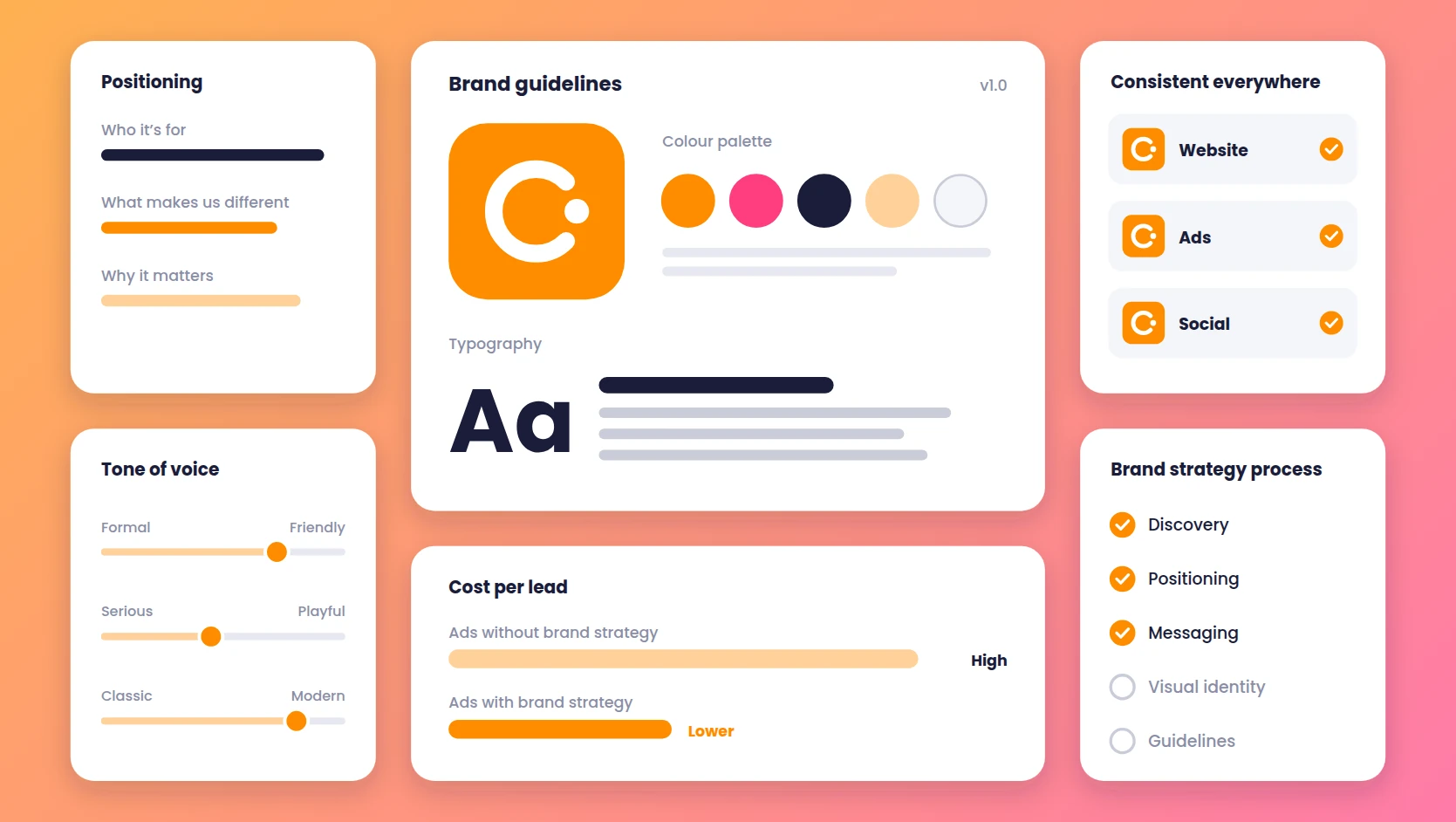
Brand strategy is often reduced to a logo and a color palette in people's minds, but that is only the most visible output of a much deeper process. Brand strategy is the set of decisions that determine how a business is positioned, what it says, and how it looks and sounds, consistently, everywhere it shows up.
A genuine brand strategy agency India businesses work with should be defining these decisions deliberately, rather than letting them emerge accidentally from whatever the founder happened to like, or whatever a freelancer delivered for a logo project five years ago.
It helps to think of brand strategy as the answer to a handful of specific questions: who exactly is this business for, what does it do differently from the alternatives available to that customer, how should it sound when it talks about itself, and how should it look everywhere it appears. Most businesses can answer these questions in some form intuitively. Brand strategy is the process of making those intuitive answers explicit, consistent, and shared across everyone who creates content for the business.
Why Ads Without Brand Strategy Underperform
Performance marketing and brand strategy are often treated as separate budgets, sometimes even separate departments, but they are deeply connected. An ad's job is to earn attention and a click. What happens after that click, whether someone trusts the brand enough to actually convert, depends heavily on whether the brand feels coherent and credible.
- Inconsistent messaging across the website, ads, and social media creates subtle friction that makes a business feel less trustworthy, even if nobody can articulate exactly why
- A visual identity that looks different across every touchpoint forces new visitors to work harder to confirm they are still looking at the same business
- Generic positioning, sounding like every competitor's ad, means the message has to work much harder to earn attention, driving up cost per click and cost per lead
- Without a memorable brand, paid traffic does not compound. Someone who clicked an ad six months ago and forgot the brand entirely has to be re-acquired at full cost, rather than returning directly because the name stuck
This is the quiet cost of skipping brand strategy: not that the ads fail outright, but that every campaign has to work harder and cost more than it would if the brand itself were doing some of the work. Over months and years, this compounds into a meaningfully higher customer acquisition cost than a competitor with the same ad budget but a clearer, more consistent brand behind it.
Signs Your Business Needs Brand Strategy Before More Ad Spend
- Your website, social media, and any print materials look like they belong to three different companies
- You struggle to describe what makes your business different from competitors in one or two sentences
- Cost per lead has been rising steadily even though the offer and targeting have not changed
- Team members describe the brand's tone and personality differently from each other
- Ad performance improves temporarily with a new creative, then fades quickly, suggesting the underlying positioning is not resonating on its own
If two or more of these sound familiar, more ad spend is unlikely to fix the underlying issue. A brand strategy engagement usually will.
How Brand Strategy and Performance Marketing Work Together
The most effective way to think about this is not brand strategy instead of performance marketing, but brand strategy as the foundation performance marketing runs on. A clear positioning statement makes ad copy easier to write and more consistent across every campaign. A defined visual identity makes ad creative instantly recognizable as your business, even in a crowded feed. Consistent messaging means a lead who sees three different touchpoints, an ad, the website, and a follow-up email, receives one coherent story instead of three disconnected ones.
This connects directly to the earlier comparison of performance marketing versus traditional advertising: regardless of which channel carries the message, a strong brand strategy makes every channel more efficient, because the audience already has some sense of who you are before they even see the ad.
A Simple Way to See the Difference
Picture two businesses in the same industry, spending the same monthly ad budget on nearly identical offers. The first has never defined its positioning, so its ad copy reads similarly to every competitor's, its landing page looks different from its Instagram page, and its logo has been redrawn twice by different freelancers with no shared brief. The second has a clear point of view about who it serves and why, consistent visual identity across every touchpoint, and messaging that sounds the same whether someone encounters it on an ad, the website, or a sales call.
Both businesses might see similar click-through rates initially, since the ad platforms reward similar targeting and bidding regardless of brand strength. The difference shows up after the click: the second business converts a higher share of visitors, because everything they see reinforces the same clear, credible story. Over months of consistent spend, that gap compounds into a meaningfully lower cost per lead for the business that invested in brand strategy first.
What to Expect From a Brand Strategy Engagement
A proper brand strategy process, rather than a quick logo redesign, typically includes a few distinct phases.
- Discovery: understanding the business, its customers, competitors, and current market position, usually through interviews and research rather than assumptions
- Positioning workshop: defining who the business serves, what makes it genuinely different, and why that difference matters to the customer
- Messaging framework: core messages, tone of voice, and how to talk about the business consistently across website, ads, and social media
- Visual identity: logo, color palette, and typography that reflect the positioning, not just what looks visually appealing in isolation
- Brand guidelines: a reference document that keeps every future piece of content, from a new team member's first social post to a large ad campaign, consistent with the strategy
The output should feel less like a design deliverable and more like a decision-making framework that makes every future marketing choice faster and more consistent. A well-documented brand strategy means a new hire, a freelance designer, or an external agency can all produce on-brand work without needing to ask the founder to weigh in on every decision. These same fundamentals apply broadly — see our guide on how to choose a digital marketing agency in India for the wider evaluation checklist.
Quick Questions About Brand Strategy in India
Is brand strategy only relevant for large businesses?
No. Smaller businesses often benefit more, since they typically have tighter marketing budgets and cannot afford to waste ad spend on a message that is not resonating. A clear, differentiated position matters just as much, if not more, when every rupee of spend needs to work harder.
How long does a brand strategy engagement usually take?
A focused engagement covering positioning, messaging, and visual identity typically takes four to eight weeks, depending on how much discovery and stakeholder input is needed. Rushing this process tends to produce generic results that do not hold up once real campaigns launch.
Can I update my brand strategy without a full rebrand?
Yes. Many businesses refine positioning and messaging without changing their visual identity at all, especially if the logo and colors are already working but the message and consistency are not.
Should I do brand strategy before or after my first ad campaign?
Ideally before, even if only a lightweight version covering positioning and core messaging. Running ads first and fixing brand strategy later usually means paying to re-earn trust and recognition you could have built into the campaigns from the start.
What happens if I skip brand strategy and go straight to a rebrand later?
It is possible, and many businesses do exactly this once they notice rising ad costs or inconsistent messaging. The tradeoff is that any brand equity built during the ungoverned period, including recognition tied to an old logo or tagline, may need to be partially rebuilt after the rebrand, which is an avoidable cost if strategy comes first.
The Bottom Line
Brand strategy is not the visual layer that gets applied after the real marketing decisions are made, it is the foundation that determines how far every rupee of ad spend actually goes. Businesses investing in positioning, messaging, and visual identity before scaling ad spend consistently see their performance marketing work harder, because the audience already has a clear, consistent sense of who the business is before the ad ever appears. The businesses that skip this step are not necessarily making a mistake, but they are paying a quiet, ongoing tax on every campaign until they eventually fix it.
If your ads are technically running but the brand behind them feels inconsistent or forgettable, book a free strategy call with CollabMate's brand team. We will give you an honest read on whether brand strategy or campaign optimization is the higher-leverage fix for your specific business.
Subscribe to newsletter
Subscribe to receive the latest blog posts to your inbox every week.
By subscribing you agree with our Privacy Policy.