For decades, advertising meant a hoarding on a busy road, a newspaper insert, or a thirty-second radio spot. It still does for a lot of Indian businesses, often simply because that is what the previous generation of owners did, and nobody has seriously questioned it since. Meanwhile, performance marketing has quietly become the default for businesses that grew up online, precisely because it answers a question traditional advertising never could: did this actually work?
This is not a case for abandoning traditional advertising entirely. It is a practical look at what each approach is genuinely good at, where the real ROI differences come from, and how to decide which one deserves your next rupee of marketing budget.
The confusion usually starts because both approaches get called "advertising" and "marketing" interchangeably, as if they compete on the same terms. They do not. One is built around exposure at scale, the other around measurable, individual action. Understanding that difference is the actual starting point, before comparing costs or results.
What Performance Marketing Actually Means
Performance marketing is any advertising where you pay based on a measurable action, a click, a lead, an install, or a sale, rather than paying a flat fee for exposure regardless of outcome. This includes Google Ads, Meta Ads, programmatic display advertising, and affiliate marketing, all tied together by the same core idea: every rupee spent is traceable to a result.
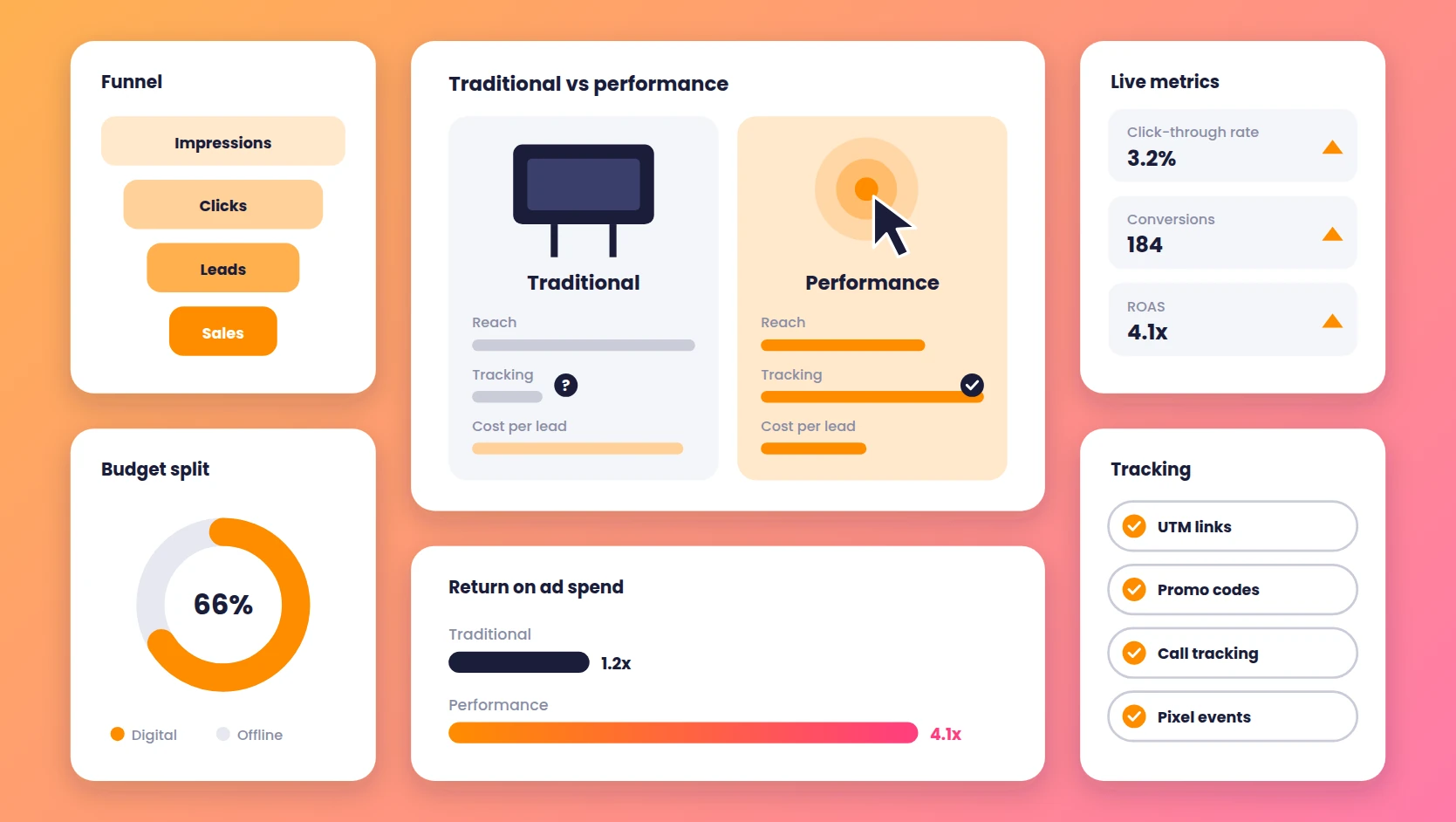
The defining feature is not the channel, it is the accountability. A performance marketing agency India businesses hire should be able to tell you, down to the campaign and even the ad, exactly what a lead or a sale cost to acquire. This level of detail simply does not exist in traditional media, where the best you typically get is an estimate of how many people may have seen an ad, with no way to confirm how many of them did anything as a result.
What Traditional Advertising Actually Means
Traditional advertising covers hoardings, print, television, radio, and local sponsorships, channels built primarily around reach and repetition rather than direct response. The underlying logic is that enough exposure to a brand, over enough time, eventually builds recall and trust, even if no individual viewer takes an immediate, trackable action.
This is not a flawed idea. Some of the most recognized brands in India built their dominance almost entirely on this model, long before digital channels existed as an alternative. The issue is not that the logic is wrong, it is that it was never designed to be measured the way digital channels can be, which makes it a poor fit for a business trying to justify spend with hard numbers.
It is also worth noting that traditional advertising's costs tend to be far less flexible. A hoarding is typically booked and paid for a fixed period regardless of results, and a television slot is priced by time and reach estimates that were agreed before the campaign ever aired, not adjusted afterward based on what actually happened.
Where Each Approach Genuinely Wins
The Real Differences, Beyond the Obvious
"Digital is measurable, traditional is not" is true but incomplete. A few other differences matter just as much when deciding where to put your budget.
- Speed to launch: a performance marketing campaign can go live within a day; a hoarding booking or a TV slot often takes weeks of lead time and fixed placement dates
- Budget flexibility: performance campaigns can be paused, scaled up, or redirected mid-month based on what is working; a print or outdoor booking is usually locked in for its full duration regardless of performance
- Targeting precision: performance marketing can reach a specific age group, location, or even people who already visited your website; traditional advertising reaches whoever happens to walk past or tune in, with no way to exclude people who are clearly not your customer
- Attribution: with performance marketing, you generally know which ad, keyword, or audience drove a specific lead; with traditional advertising, a spike in inquiries after a campaign launch is a correlation at best, rarely a confirmed cause
When Traditional Advertising Still Makes Sense
None of this means traditional advertising is obsolete. It still earns its place in a few specific situations.
- Mass local visibility for a business that depends on foot traffic in a specific area, where a well-placed hoarding can outperform digital ads that are easy to scroll past
- Categories where trust is built slowly and visibly, such as real estate or large-ticket purchases, where seeing a brand repeatedly in the physical world adds a credibility that a targeted Instagram ad alone may not
- Reaching an older demographic that consumes less digital media and more television, radio, or print in a specific region
- Pure brand-building campaigns for an already-established business with the budget to invest in long-term recall, separate from any immediate lead generation goal
The common thread is that traditional advertising still wins when the goal is broad awareness rather than a specific, trackable action, or when the target audience genuinely spends more time with traditional media than digital.
When Performance Marketing Wins, Which Is Most of the Time
For the vast majority of small and mid-sized Indian businesses, especially those needing to justify every rupee of marketing spend against actual leads or sales, performance marketing wins on pure ROI logic.
- E-commerce and D2C brands, where every sale can be directly attributed to a specific ad and audience
- Service businesses that need a steady, measurable stream of leads rather than general brand recognition
- Any business with a limited budget that cannot afford to spend on exposure with no way to verify it converted into anything
- Businesses that need to test and iterate quickly, since performance campaigns can be adjusted within hours based on real data, not months based on a gut feeling
This is also where the earlier comparison of Google Ads agency versus doing it yourself becomes relevant. Performance marketing's biggest advantage, measurability, only pays off if someone is actually reviewing the data and acting on it consistently, which is exactly the discipline a dedicated performance marketing agency India businesses hire should bring to the table.
Can They Work Together?
For businesses with the budget to run both, the strongest approach is often not choosing one permanently, but sequencing them deliberately. Traditional advertising can build broad awareness and trust in a local market, while performance marketing captures and converts the demand that awareness creates, often through retargeting people who saw the hoarding and later searched for the brand online.
This hybrid approach is common among more established Indian businesses that started with traditional advertising and added performance marketing as a complement, rather than a replacement. The key is measuring the performance side properly even when traditional advertising is running alongside it, so you can still see which channel is actually driving results.
A practical way to structure this is to treat traditional advertising as the top of the funnel, building familiarity with a brand name across a local market, while performance marketing owns the middle and bottom of the funnel, actually converting that familiarity into an inquiry or sale once someone is ready to act. Businesses that blur this distinction, expecting a hoarding alone to generate direct sales, tend to be the ones most disappointed by traditional advertising's ROI, simply because they were judging it against a job it was never designed to do.
How to Actually Calculate Which One Is Working
The clearest way to settle this debate for your own business is to force both approaches onto the same measurement: cost per result, not cost per exposure.
For performance marketing, this is straightforward: total spend divided by number of leads or sales generated. For traditional advertising, it takes more deliberate effort, but it is not impossible. Assign a unique phone number or a specific promo code to a hoarding or print campaign, and track how many inquiries or sales come through that specific channel during the campaign period. It will not be as precise as digital attribution, but it beats guessing entirely.
Once both numbers exist side by side, the decision usually becomes obvious. Businesses are often surprised to discover that a traditional campaign they assumed was working, because inquiries seemed to be up, was not the actual cause once they properly isolated the traditional channel from everything else that was happening at the same time, including seasonal demand or word of mouth. For the broader criteria that apply no matter which channel you choose, see our guide on how to choose a digital marketing agency in India.
Quick Questions About Performance Marketing vs Traditional Advertising
Is performance marketing always cheaper than traditional advertising?
Not necessarily cheaper in absolute terms, but almost always more efficient, since every rupee is tied to a measurable outcome. A hoarding might cost less per month than a performance campaign in raw numbers, but if it generates zero trackable leads, the effective cost per result can end up far higher.
Should a new business skip traditional advertising entirely?
For most new businesses with a limited budget, yes, at least initially. Performance marketing lets you test messaging and offers cheaply and quickly, which is far more valuable early on than broad, unmeasurable awareness.
How do I measure ROI on traditional advertising if it is not directly trackable?
The most reliable methods are unique phone numbers or promo codes specific to the traditional campaign, and asking new customers directly how they heard about you. Neither is perfect, but both give a rough signal where none would otherwise exist.
What is the biggest mistake businesses make when comparing the two?
Comparing raw cost instead of cost per result. A cheaper channel that produces nothing measurable is not actually a bargain, and a more expensive channel that reliably produces leads or sales is not actually expensive once you calculate the real cost per outcome.
How long should I run a performance marketing campaign before judging if it works?
Most channels need at least two to four weeks of consistent spend before the data is reliable enough to judge fairly, since early results can be skewed by the learning phase most ad platforms go through when a new campaign launches.
The Bottom Line
Performance marketing wins on ROI for the vast majority of Indian businesses today, because it is measurable, flexible, and fast to adjust. Traditional advertising still has a place for mass local visibility, trust-heavy categories, and pure brand-building, but it should be chosen deliberately for those reasons, not by default because it is what has always been done.
If you are trying to figure out where your next marketing rupee should go, book a free strategy call with CollabMate's performance marketing team. We will give you an honest read on where the real ROI is for your specific business, not a generic answer.
Subscribe to newsletter
Subscribe to receive the latest blog posts to your inbox every week.
By subscribing you agree with our Privacy Policy.